Statement of the jury
The components manufacturing division at the BMW Group Landshut plant utilises a wide range of manufacturing and automation technologies, which opens up new opportunities for the plant, particularly during the transition to e-mobility driven by new products. For example, technological expertise in the industrialisation of products such as the Energy Master or the electric motor housing for the New Class leads to innovative product and/or process improvements, which in turn are reflected in quality, increased efficiency and competitiveness, the speed of innovation and industrialisation, and sustainability.
From a strategic perspective, it is thereby essential for the components manufacturing division:
- to contribute to product and process innovations,
- to strengthen the assessment and competence-building capabilities of both our own staff and across the entire value chain,
- to ensure the (regular) supply of our own components and, where necessary, to provide support for third-party suppliers,
- to utilise digitalisation and AI as a gamechanger,
- to achieve the ambitious sustainability goals.
The forward-looking strategy for component manufacturing forms the foundation for a consistent focus on value creation, stability and excellence in production. From the plant’s perspective, the value-added production system (WPS) can never be embedded deeply enough. For this reason, managers in Landshut are trained in their lean routines. The result: the processes, value stream management and shop floor management are exemplary.
The next boost will come from digitalisation and AI. Most plants have an analogue CIP workshop – Landshut also has a digital CIP workshop. It acts as an enabler for digital transformation and skills development. The current focus is on the AI LAB, the ‘plug-and-play installation’ of optical systems, and the integration of citizen developers throughout the organisation. The BMW Group Landshut plant is not just talking about physical AI, but is focusing on collaborative software stack development, the integration of data, robotics and use cases in component manufacturing.
Despite the consistent focus on digitalisation, automation and AI – which is also evident in the excellent applications at the plant – there are just as many ingenious low-cost solutions.
The jury noted that the Landshut plant has achieved outstanding results in all areas of technology, support and capability in recent years and is very well positioned to meet future challenges – particularly with regard to e-mobility. The jury is convinced that the Landshut plant will continue to make significant contributions in the future. And these extend far beyond the mere production and on-time delivery of parts. That is why this year’s Automotive Lean Award in the ‘OEM Component Manufacturing’ category goes to Landshut.

The plant
The BMW Group is one of the world’s leading premium car manufacturers, bringing together the BMW, MINI and Rolls-Royce brands under one roof. In 2025, the company consistently pursued its strategy of sustainable mobility and continued to invest in electric mobility, digitalisation and innovative manufacturing technologies. With a global production network and a strong international market presence, the BMW Group is one of the automotive industry’s global players. In 2025, the BMW Group achieved revenue of €133.5 billion despite challenging conditions. At the same time, the company continued its growth in the fully electric vehicle segment and saw a slight increase in global vehicle sales. At the end of 2025, the BMW Group employed 154,540 people worldwide.
Employees
Ca. 154.540
Revenue 2025
133,5 Mrd. €
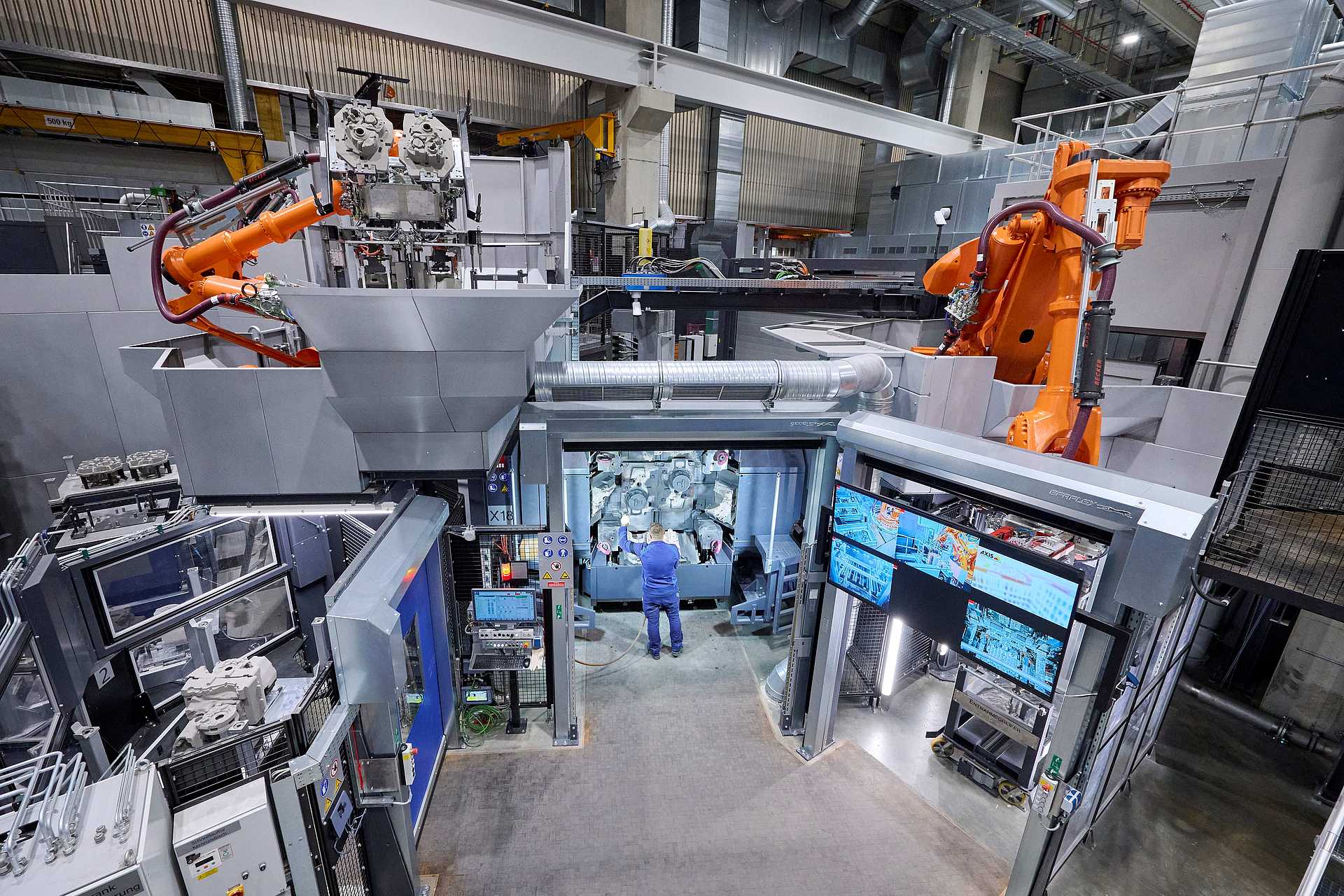
The Landshut plant is an integral part of the BMW Group’s supply chain and is therefore firmly embedded in the BMW Group’s global procurement and supplier network. As the largest components plant, the Landshut site is the centre of excellence for innovation, technological diversity and efficiency. Around 3,800 employees manufacture approximately 5 million components annually. Key technologies include light-metal casting, plastics and composites technology for interior and exterior components, powertrain and chassis technologies, as well as electrical and electronic manufacturing for electromobility and high-voltage systems. In total, approximately 7,300 employees work in the BMW Group’s component manufacturing operations across seven sites.
Address
Ohmstraße 2
84030 Landshut
Germany
Products
Engine, chassis and structural components; electrical and electronic components; plastic components for the vehicle exterior, including paintwork; bodywork components made from fibre-reinforced plastics; cockpit and interior fittings; engines and drive shafts.
Employees
Ca. 3,800
Congress organisation
phone +49 89 44 388 99 22
lean.award(at)agamus.com